

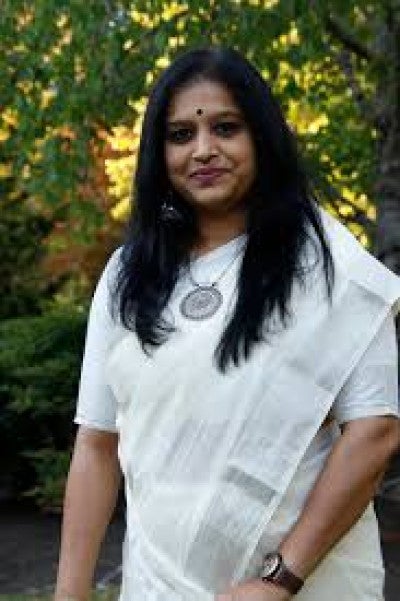
Madhurasmitha (Smitha) Chakravarthy grew up across multiple cities in India, imbibing many cultures and languages, and has been a resident of Portland, OR since 2003. A musician and composer, Smitha continues to volunteer at Portland Balaji Temple as a music teacher for the last 10+ years, with over 60 students annually. Her command over multiple Indian languages (Telugu, Tamil, Kannada, Malayalam, Sanskrit and Hindi), and her in-depth training in music and dance enable her to provide holistic art education to her students.
Bio
Chakravarthy is deeply rooted in two traditional South Indian classical art forms: Carnatic music and Bharatanatyam dance. Carnatic music, with its intricate ragas (melodic frameworks) and talas (rhythmic cycles), is one of the oldest systems of music in the world and is often performed in both formal and cultural settings. Bharatanatyam, similarly, is an ancient dance form that combines expressive movements, rhythmic footwork, and storytelling through intricate hand gestures (mudras) and facial expressions. Chakravarthy says: "I would not be able to tell you what my life would be without music as I have never been able to separate them. What makes my role impactful in the diaspora is how I incorporate these traditions into everyday life." Through her teaching practice, which includes training over 80 vocalists and percussionists, Chakravarthy fosters a routine of regular practice, which is central to mastering these art forms. In this way, Carnatic music and Bharatanatyam are not only reserved for formal performances but are also part of her students' daily lives. For her, these art forms go beyond special occasions. They are a continuous, evolving practice, involving regular rehearsals, classes, and mentoring. The tradition of teacher-student interaction is reflected in Chakravarthy's teaching, where she provides comprehensive training in music and dance that her students engage with consistently, developing both technical skill and depth in these art forms. By doing so, these traditions become an essential part of the cultural rhythm of her students' lives, rather than being limited to specific events or festivals.